URL
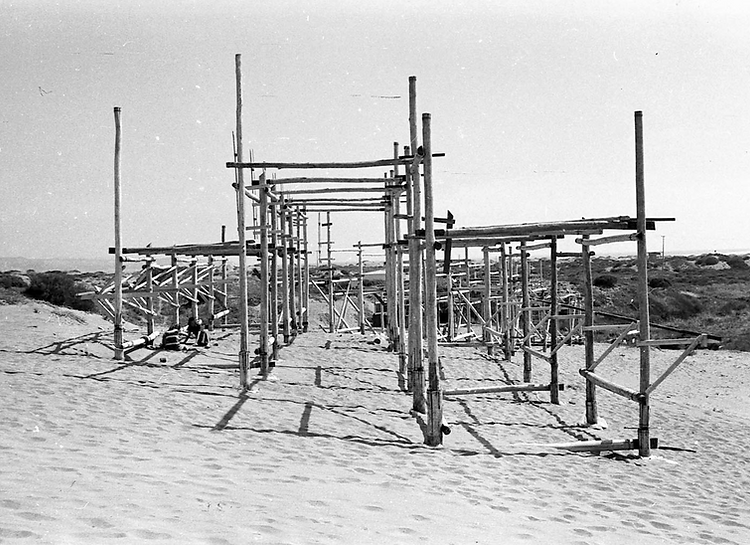
The Ciudad Abierta has maintained a low constructive and demographic density considering its 50 years of existence in almost 300 hectares. There are only 16 inns, inhabited by a total of 43 people. Architect Victoria Jolly is a current dweller. For younger generations, she explains, the Ciudad Abierta is somehow distant from pedagogy, not being a school of architecture itself, but remains a site to be explored: ‘It is still in the process of becoming. It is a territory that lingers in its own transformation, and exists to be inhabited.’ This is why it is far from being an architectural laboratory, or some kind of off-site campus. The Ciudad Abierta is a collective poetic creation.
The Ciudad Abierta welcomes learnings and exchanges from other latitudes, such as the workshops and seminars on concrete textile moulds run by Cooper Union professor Mark West during his stay in Ritoque in 2014. His work intersected with Eyquem’s own explorations on flexible forms using geotextiles’ resistance to the weight and traction of the mortar. A former student of Eyquem, Jolly sees her own work in continuity with paths walked by others. In her work with concrete, she explores a fluid material that is received by a flexible membrane; when both meet, gravity participates in the process of shaping the architectural element. This search is being tested in a number of columns distributed across the dunes, and it is the structural foundation for a new work under construction, the Pórtico de los Huéspedes (Guests’ Porch). To build this porch, they have created the Ciudad Abierta Research Platform, a joint research project with ETH Zürich, the Architecture Academy of Università della Svizzera Italiana, and the École Polytechnique Fédérale de Lausanne (EPFL), that since 2014 have worked together in summer workshops involving exchange of students and professors. The porch has been developed together with Patricia Guaita and Rafael Baur (EPFL), and Victoria and David Jolly at the Ciudad Abierta; it is the result of collaborations infused with the thinking of architecture as a collective practice. Even if it is possible to identify individual authors, their names tend to blur, becoming anonymous ‘works’.